

a fairytale

spring 4There once was a land, a far away place, where a small people lived in small houses. They had learned to live in silence, for silence was their legacy from the Darkness that had retreated from their land. They had lived through the dark and darkest days and had survived, and now were toiling away in silence, accepting their fate. They were blessed however, with fertile land, and underneath this land, they found many precious artifacts buried, artifacts that were easily shattered and broken if not handled with care. The small people learnt day by day to dig up these artifacts carefully with small shovels and small wheelbarrows, making sure to only use the small tracks they knew, for they did not know where other artifacts may lay, and there were places where the Darkness still lingered.

So they learnt, carefully, and did their best to tend to and put together the artifacts with care. Some stayed together, others fell apart repeatedly, and yet others were no more than ground dust, and those the small people buried in their small graves.  However, with every passing day, more and more artifacts were put together, and both young and old knew that one day these artifacts would lead to wealth and prosperity. It would be a day far away, but that day would come, and so they toiled away.

Then, one day, a runner came, and proclaimed that there was a loud cry among the other kingdoms and realms. It was found that the Lord of the Dark had lost his most precious gem, and it was said that gem was needed to defeat his armies. The small people listened and trembled for they knew that hard merciless stone, and knew the Lord of the Dark had many like it. He cast away one and put on another, and many were scattered beyond the small pathways they would not leave. Yet the cry was loud among the other kingdoms and realms, and scouts and men were sent out to find this gem, for the cry was great to find this lost thing, and the small people could do nothing to sooth the loud cry to silence.

And so the day came, and the machines rolled down the small people’s tracks, destroying the pathways and the artifacts underneath. Trees were hewn and soil dug up, dynamite was stuck into holes, blowing up the land wide. And the small people stood aside and watched in horror and dismay as the precious artifacts were flung into the air and shattered. And many cried, for it was to them as if the Darkness had returned again. And there were some among them who lost all hope and understood why the Lord of the Dark said there was no hope, only the Darkness beyond. And they ran and fled into the Darkness and were never seen again, except in nightmares that lurked in the night.


© 2014 threegoodwords
don’t listen

writing 1 typewriter 1

A blank page can be an awful thing. It seems empty, but it isn’t. It’s filled with possibilities, words written, deleted, rewritten, crossed out, thought over, emphasised, loved, hated, wanted, reviled – and it never ends either.

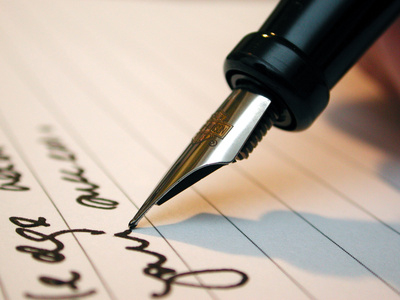
I think the hardest part is to not listen. You know, those ‘Are you serious’ ‘Are you sure about this?’ ‘Is that good enough?’ and ‘Is that it?’ that whisper from the blankness of the page, sounding out the words in your head. And then it happens, the whispers grow louder and louder, talk, yell, shout and scream and suddenly you’re saying: ‘No no no no no no no no!’ It’s wrong! bad! awful! horrible! blergh!

Delete. Delete. Delete.

And then you’re back to square one, that blank page, that empty space that somehow is already filled with all the things you don’t want to say, all the things you wish to convey, and really need to get on the page. And the whispers just won’t go away.

So many times, too many times, listening has made me do something stupid – that is, I deleted everything in sudden horrified shame, which also meant all the words were gone, never to be retrieved, never to be seen again.

I stopped that.

I keep everything that makes me hesitate, sometimes even squirm, even the silliest scraps of words on paper. I keep them for one reason: between those words, hidden among the letters, there is usually something real, a thought, a word, a memory that I can use later when I know what it is that I’m after. It’s not always like that. Sometimes what I wrote is just really, really bad.

It’s sieving through the whispers and finding my inner compass that’s so difficult. The whispers like to override that gut-feeling that 9 times out of 10 is accurate, and even the tenth time it was right somehow. The whispers that seem to come out of the emptiness, they can get too loud, and the trick is not easy but possible: just don’t listen. Write it down. Write it all down. Even that sentence you know is silly. Even that word you just don’t want to use. Write it down. See it written out so that you know why it’s so horrible. It’s helped me countless times. In a way, when I see it written out, I finally know what’s so wrong with it. Until then it’s just words swirling in my head.

Then I let it rest for a while. Sometimes for a few days, sometimes a few weeks, it can go into months and years actually, but eventually I go back, and read everything one more time. It surprises me time and again how different the words look and sound just becomes some time passed. If I’m happy with it, I edit what needs editing, re-write, re-draft and re-do until it’s roughly where I wanted to be. Then I start over until I finally feel ‘Yeah… that’s about right.’ This takes time of course, and it can be (very) frustrating, but what really helps me is reading the books, poems and short stories I love best. They’re the proof that someone successfully managed to silence the whispers coming out of the (apparent) emptiness.

At one point I had something of a database of crap sentences, horrible plot twists, stupid little dialogues I wanted to turn into genuine conversations and failed, failed, failed. I keep them though, and go back to them when I can overcome the inner cringe, and sometimes – I can’t tell you how or why, there is a mystery to this craft of ours – I find that seed of thought, of feeling that I was aiming for and work from there.

© 2014 threegoodwords

once upon a time

words words words

Words are tricky. Each one has its own character. Some come all sweet and simple, and suddenly get complicated without you knowing how it happened. Synonyms you never heard of turn up like juniper berries and pepper seeds – the taste, the flavour, is overwhelming. Meanings melt down everything in that one second you weren’t looking. And then there are those words that look perfectly solid, wonderfully whole – and they can’t even hold a sentence. Others transform in one paragraph and won’t fit anymore, no matter how you try to squeeze. food 4They’re too there, too present, sitting there, staring you in the face, daring you to keep them there like oysters on a plate … So after all the cutting and stirring, after hours and hours of tasting, testing, and rearranging everything … it all boils down to which word fits, which one’s the right pinch of salt, and which one’s perfect, exactly what you were aiming for, exactly what you wanted.

© 2014 threegoodwords

Anna Fonte's Paper Planes

Words, images & collages tossed from a window.

Classic Jenisms

Essays, notes & interviews on why literary fiction matters to human living

von reuth

small press. great publishing.

a thousand and one books

but don't take my word for it

Kristiane Writes

Home hub & scribble space of Prose Writer & Poet Kristiane Weeks-Rogers (she/hers), author of poetry collection: 'Self-Anointment with Lemons'.

The 100 Greatest Books Challenge

A journey from one end of the bookshelf to the other